Is this book for you?
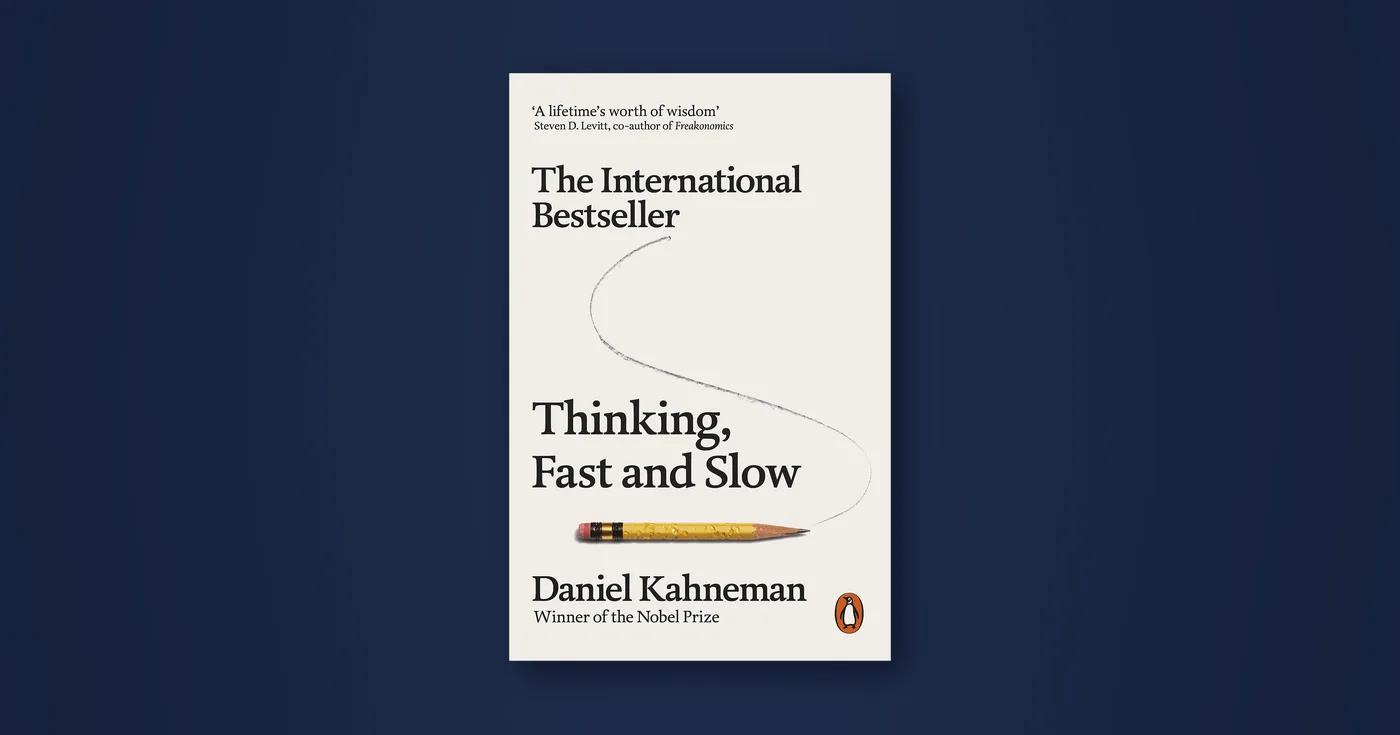
Thinking, Fast and Slow
Read it if…
- You've made a decision that felt obviously right, then wondered what you were thinking.
- You want to know why your gut is sometimes brilliant and sometimes badly wrong.
- You make calls at work on money, people or risk and want to make them better.
- You enjoy surprising experiments that reveal how the mind really works.
- You want the original book behind ideas like loss aversion and cognitive bias.
Watch the summary
What the book is about
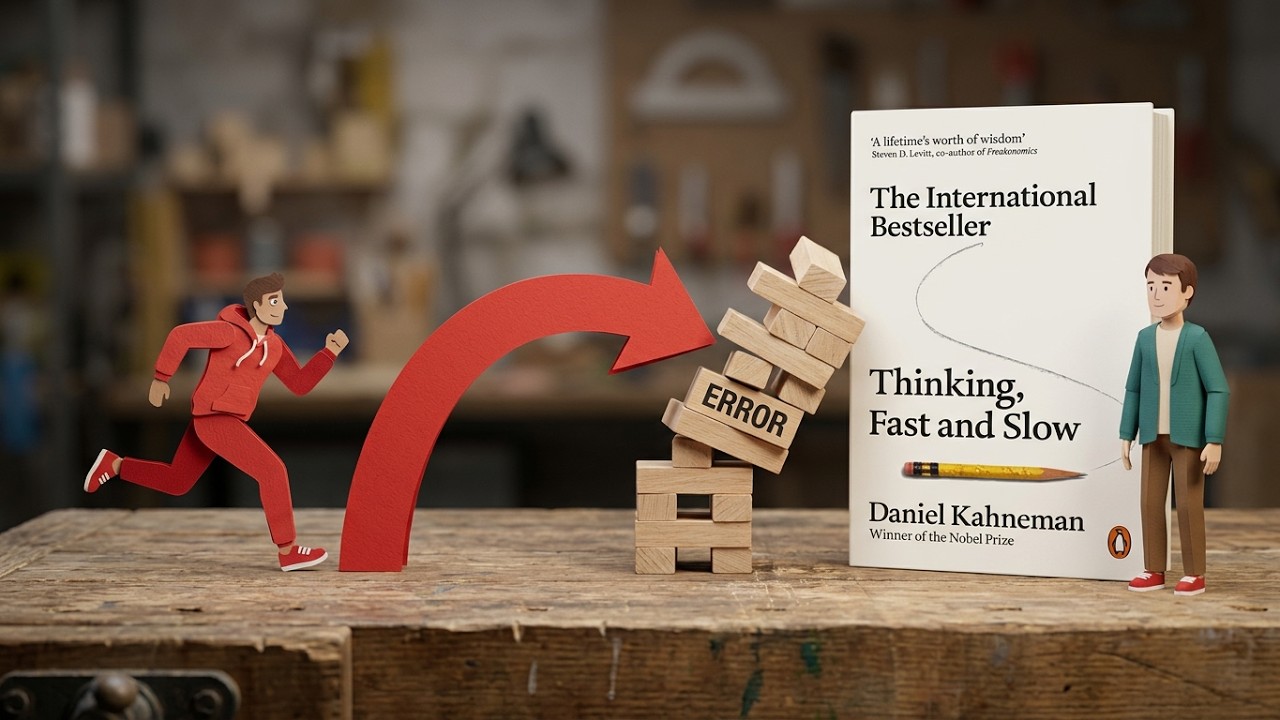
Why do we make the choices we do? Daniel Kahneman’s answer is that two very different kinds of thinking run your mind. One is quick, automatic and emotional. The other is slow, effortful and logical, and it’s lazier than you’d like to believe.
Drawing on decades of experiments, the book shows how the fast system shapes far more of your judgements than you realise, where it serves you well, and where it trips you up in predictable ways. It closes with practical ways to catch those mistakes in your own life and work.
What’s inside
System 1 The fast, intuitive mind that reads faces, finishes sentences and jumps to conclusions without being asked.
System 2 The slow, deliberate mind that handles hard sums and careful choices, and often signs off on whatever System 1 suggests.
Heuristics and biases The mental shortcuts that make us judge by what’s vivid, recent or easy to recall, and the errors they lead to.
Anchoring How a random number can quietly pull your estimates, from prices to judgements, towards it.
Overconfidence Why we trust stories that hang together, and why experts’ predictions are often less reliable than they feel.
Loss aversion The heart of prospect theory: losing something hurts more than gaining the same thing pleases.
Two selves The experiencing self who lives your life and the remembering self who keeps score, and why they often disagree.
Who wrote it
Daniel Kahneman was a psychologist and the Eugene Higgins Professor of Psychology, Emeritus, at Princeton University. In 2002 he won the Nobel Prize in Economics for the work he did with Amos Tversky on how people judge and decide under uncertainty, research that helped found behavioural economics. He also received the US Presidential Medal of Freedom. Thinking, Fast and Slow brought his life’s work together for general readers for the first time. He died in March 2024, aged 90.
What readers are saying
What they love: Readers say it changes how they see their own decisions, at work and at home. They enjoy the everyday experiments that make each idea land, and many describe it as a book to keep on the shelf and return to, picking up something new each time.
What well-known names said: The Financial Times called it the one “masterpiece” among books on human rationality. Steven D. Levitt, co-author of Freakonomics, called it “stunningly profound”. The New York Times Book Review named it one of the ten best books of 2011.
Quick facts
- Author
- Daniel Kahneman
- Publisher
- Penguin (first published by Allen Lane in 2011)
- Length
- 499 pages
- Published
- 10 May 2012 (UK paperback)
- Formats
- Hardback, paperback, ebook and audiobook, read by Patrick Egan
- Recognition
- Over 10 million copies sold. Winner of the National Academy of Sciences Best Book Award and the Los Angeles Times Book Prize
- Reading time
- Around 12 to 15 hours
- Difficulty
- Moderate. Long and detailed, but no maths or psychology background needed.
Our verdict
If you want to understand why smart people make predictable mistakes, including you, this is the book to get. Daniel Kahneman's two systems, one fast and intuitive, one slow and careful, give you a simple way to spot when your gut is leading you astray. It rewards reading a chapter at a time and coming back to it. The unabridged audiobook, read by Patrick Egan, runs about 20 hours.
WillYouRead.com is independent and not affiliated with the author or publisher. This page is a guide to the book, not professional or medical advice.
More in Brain, mind and psychology
- The DOSE Effect by TJ Power
- Dopamine Nation by Anna Lembke
- The Molecule of More by Daniel Z. Lieberman and Michael E. Long (coming soon)
- Why Has Nobody Told Me This Before? by Dr Julie Smith (coming soon)
- Chatter by Ethan Kross (coming soon)
- The Chimp Paradox by Prof Steve Peters (coming soon)