Is this book for you?
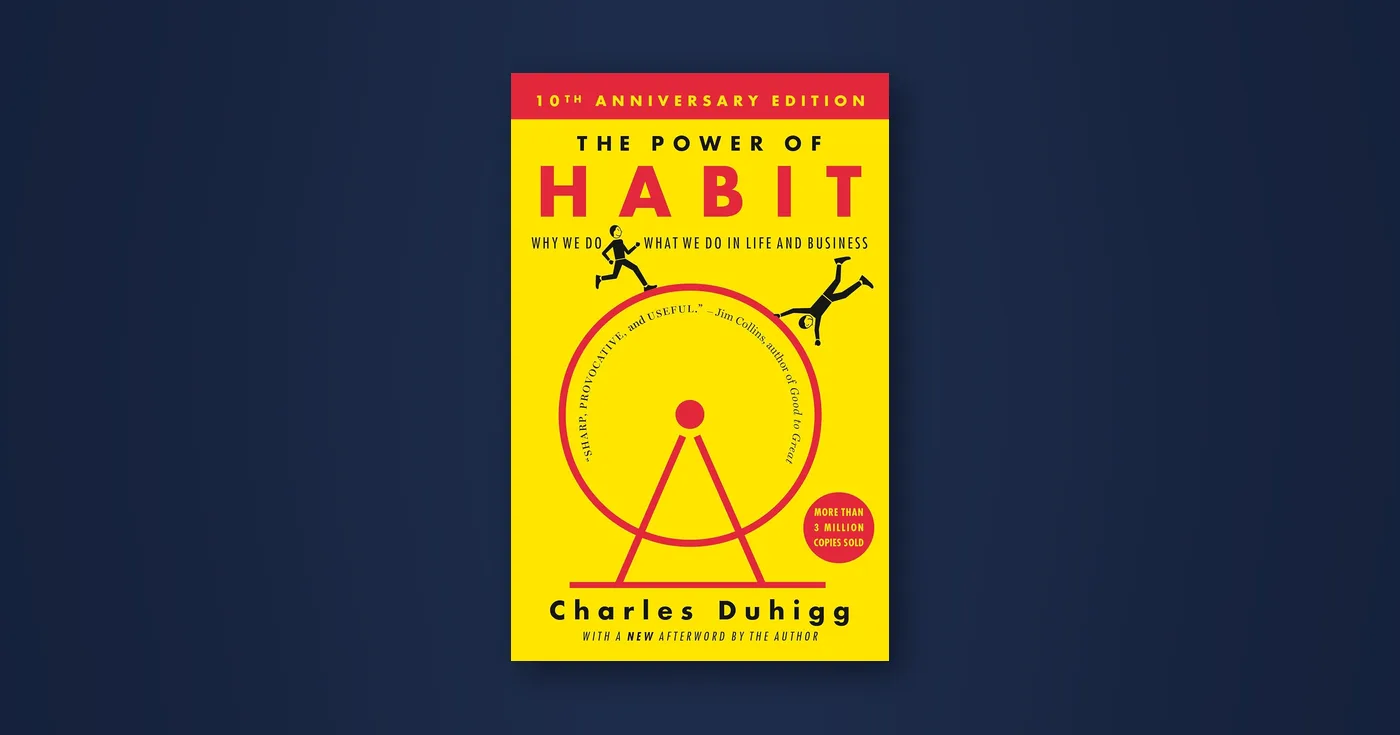
The Power of Habit
Read it if…
- You keep trying to change a habit and keep slipping back into it.
- You want to understand why you do so much on autopilot.
- You enjoy big true stories more than lists of tips.
- You lead a team and want to change how people work.
- You've heard of the habit loop and want the book that made it famous.
Watch the summary

What the book is about
Most of what we do each day isn’t a decision at all. It’s habit. Charles Duhigg, an award-winning journalist, sets out to explain how habits form in the brain, why some are so hard to shift, and what actually works when you want to change one.
He follows the idea across three levels: your own life, the companies you work for, and whole communities. Along the way he shows how habits shaped the success of swimmer Michael Phelps, Starbucks and the American civil rights movement, and how big businesses study our habits to sell to us.
What’s inside
The habit loop Every habit runs on the same three steps: a cue that triggers it, a routine you carry out, and a reward that makes your brain want to repeat it.
The craving brain Habits stick because we start to crave the reward before we get it. Duhigg shows how companies built products like Febreze around that craving.
The Golden Rule of Habit Change You can’t simply delete a bad habit. Keep the same cue and the same reward, and swap in a different routine.
Belief makes it stick Changed habits tend to last when people believe change is possible, often with the support of a group.
Keystone habits Some habits set off a chain of others. Paul O’Neill turned around the aluminium giant Alcoa by focusing on one thing: worker safety.
Willpower as a habit Self-control can be trained like a muscle. Starbucks teaches staff set routines so they stay calm under pressure.
Habits inside companies Organisations run on habits too, and a crisis can be the moment to reset them. Duhigg also shows how retailers like Target analyse shopping habits to predict what customers want.
Habits of whole societies Movements spread through strong friendships, weaker social ties and shared habits, as in the Montgomery bus boycott.
Who wrote it
Charles Duhigg is a Pulitzer Prize-winning investigative journalist. He was a reporter at The New York Times from 2006 to 2017 and now writes for The New Yorker and The New York Times Magazine. He was also the founding host of the Slate podcast How To! with Charles Duhigg.
He is a graduate of Yale College and Harvard Business School. His other books are Smarter Faster Better and Supercommunicators.
What readers are saying
What they love: Readers find it easy to read and hard to put down, thanks to the gripping true stories. Many say the habit loop gave them a simple way to understand their own routines for the first time. The appendix stands out, where Duhigg shows step by step how he broke his own afternoon cookie habit, so you can follow the same method.
What well-known names said: The Financial Times called it an “essential manual for business and living”. Jim Collins, author of Good to Great, described its core insight as sharp, provocative and useful. The Economist praised the depth of research behind it and its balance of serious ideas with practical advice.
Quick facts
- Author
- Charles Duhigg
- Publisher
- Random House Books
- Length
- 400 pages (UK paperback)
- Published
- 28 February 2012 (first edition)
- Formats
- Paperback, ebook and audiobook, read by Mike Chamberlain
- Recognition
- Over 3 million copies sold. New York Times bestseller for more than three years
- Reading time
- Around 7 hours
- Difficulty
- Easy. Story-led, no science background needed.
Our verdict
If you keep making the same resolutions and sliding back into old routines, this is the book that explains why, and how to break the cycle. Duhigg's habit loop of cue, routine and reward gives you a simple way to spot what really drives a habit, then swap the routine for a better one. It's built on long true stories, so if you want the practical steps fast, read the first three chapters and the appendix first. The audiobook, read by Mike Chamberlain, runs just under 11 hours.
WillYouRead.com is independent and not affiliated with the author or publisher.
More in Habits and productivity
- Atomic Habits by James Clear
- Deep Work by Cal Newport
- Essentialism by Greg McKeown
- The 7 Habits of Highly Effective People by Stephen R. Covey (coming soon)
- Eat That Frog! by Brian Tracy
- Four Thousand Weeks by Oliver Burkeman