Is this book for you?
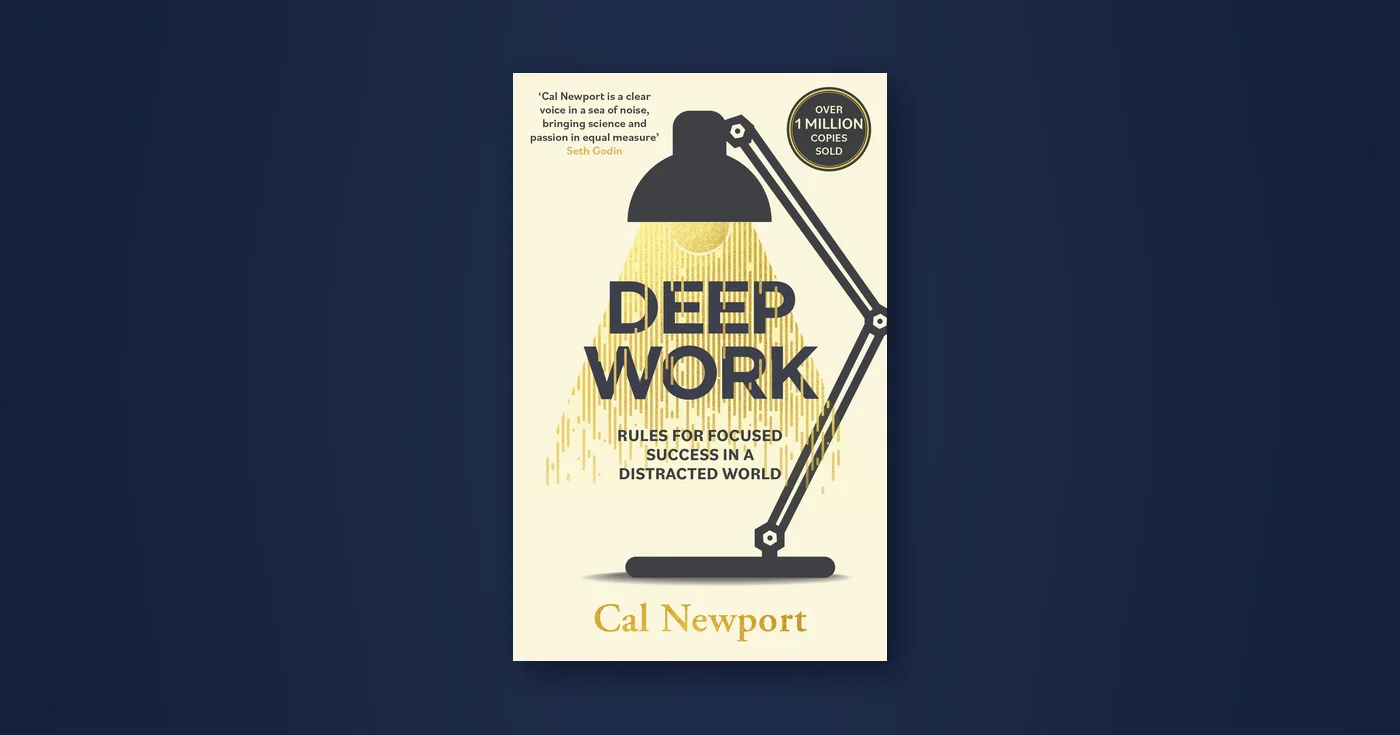
Deep Work
Read it if…
- You finish busy days with emails answered but your most important work untouched.
- You reach for your phone the moment a task gets hard.
- You want to produce better work without adding more hours.
- You work in a job where thinking clearly is the whole job.
- You're curious what life looks like with far less social media.
Watch the summary

What the book is about
Deep work is the ability to focus without distraction on a demanding task. Cal Newport argues it’s becoming rarer just as it’s becoming more valuable, because most of us now spend our days in a constant blur of email, chat and quick checks of our phones.
The first half of the book makes the case for focus: why it matters for your career, why so few people manage it, and why it makes work more satisfying. The second half is a training plan, with four rules for building the habit and protecting it in a busy, connected job.
What’s inside
Deep work versus shallow work The difference between hard, focused thinking that creates real value and the easy, interruptible tasks that fill most working days.
Valuable, rare and meaningful Newport’s three-part case that focus pays off at work, that it’s getting scarcer, and that it leads to a more satisfying working life.
Rule one: Work Deeply Four ways to fit deep work into your schedule, from shutting yourself away completely to grabbing focused hours wherever you can, plus rituals that make starting easier.
The shutdown ritual A set routine to end each workday, so unfinished tasks stop circling in your head through the evening.
Rule two: Embrace Boredom Why filling every spare moment with your phone weakens your ability to concentrate, and how to train it back.
Rule three: Quit Social Media Treat each platform as a tool and keep it only if its benefits clearly outweigh the cost to your time and attention.
Rule four: Drain the Shallows Plan your day in blocks, shrink low-value tasks, and accept that a few hours of deep work a day is a strong result.
Who wrote it
Cal Newport is a Professor of Computer Science at Georgetown University, where he is a founding faculty member of the Center for Digital Ethics and director of its Computer Science, Ethics and Society programme. He earned his PhD at MIT.
He is a long-time contributing writer for the New Yorker and hosts the Deep Questions podcast. His other books include Slow Productivity, A World Without Email, Digital Minimalism and So Good They Can’t Ignore You, which together have sold millions of copies in more than 45 languages.
What readers are saying
What they love: Readers say it’s easy to follow and full of practical steps rather than vague advice. Many describe changing how they plan their days after reading it, and the memorable stories, such as Carl Jung building a stone tower in the woods to think, make the ideas stick. Plenty recommend pairing it with Newport’s So Good They Can’t Ignore You.
What well-known names said: The Economist called deep work “the killer app of the knowledge economy”. Ezra Klein says the book led him to stop booking morning meetings so he could keep that time for creative work, and Mel Robbins has recommended Newport to anyone feeling overwhelmed.
Quick facts
- Author
- Cal Newport
- Publisher
- Piatkus (Little, Brown)
- Length
- 304 pages
- Published
- 5 January 2016 (paperback)
- Formats
- Paperback, hardback, ebook and audiobook, read by Jeff Bottoms
- Recognition
- Bestseller, over one million copies sold
- Reading time
- Around 5 to 6 hours
- Difficulty
- Easy to moderate. Clear writing, some big ideas.
Our verdict
If your days disappear into emails, messages and meetings while your real work waits, this is the book to get. Cal Newport gives you four clear rules for building long stretches of focus into an ordinary working week. It suits anyone whose job depends on thinking well, and it's best read with a diary open so you can block out time as you go. The unabridged audiobook runs just under eight hours.
WillYouRead.com is independent and not affiliated with the author or publisher.
More in Habits and productivity
- Atomic Habits by James Clear
- The Power of Habit by Charles Duhigg
- Essentialism by Greg McKeown
- The 7 Habits of Highly Effective People by Stephen R. Covey (coming soon)
- Eat That Frog! by Brian Tracy
- Four Thousand Weeks by Oliver Burkeman