Is this book for you?
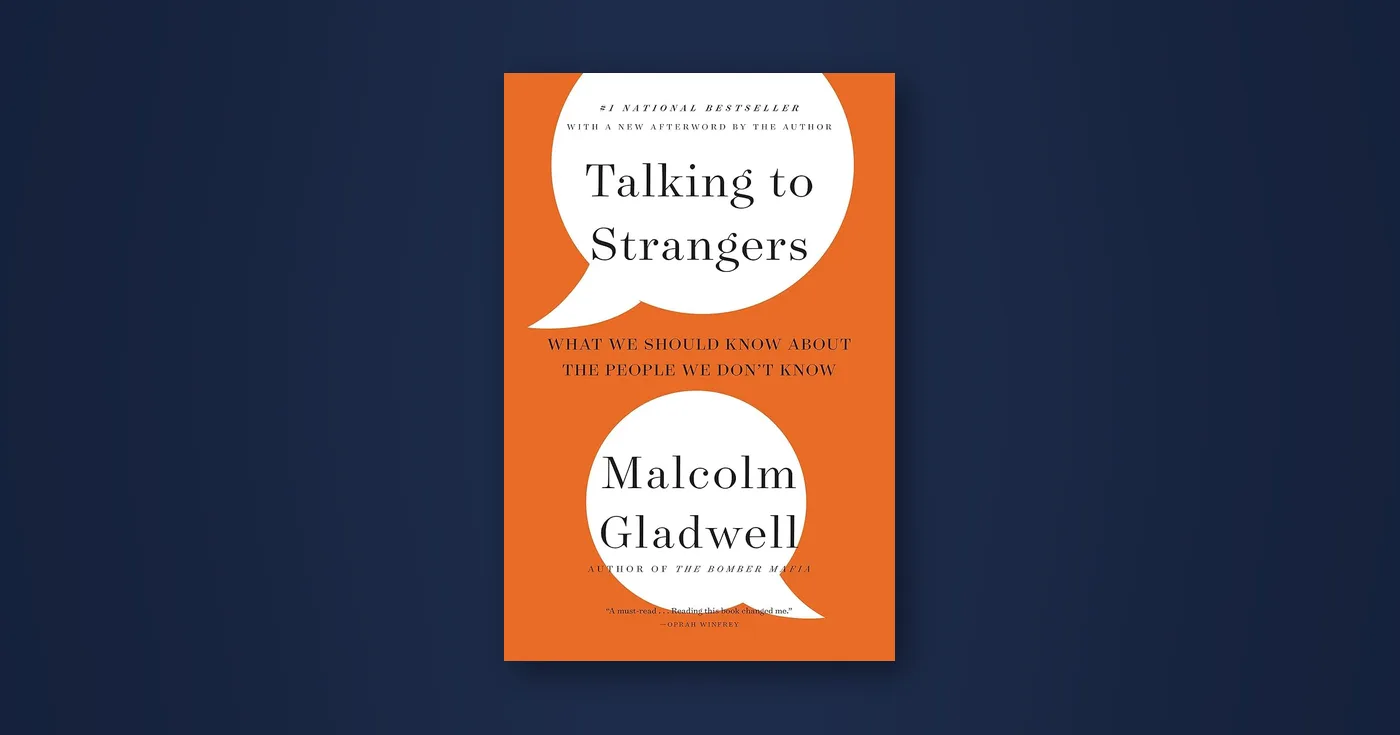
Talking to Strangers
Read it if…
- You've ever trusted someone completely and later wondered how you missed the signs.
- You think you can usually tell when someone is lying to you.
- You love true stories that read like thrillers: spies, fraudsters and famous trials.
- You want to understand why so many news stories begin with a simple misunderstanding.
- You've enjoyed Gladwell's other books or his podcast, Revisionist History.
Watch the summary

What the book is about
Why do we so often get other people wrong? Why is it so hard to spot a lie, read a face or judge what a stranger really means? Malcolm Gladwell sets out to answer those questions through a run of real encounters that went badly: a spy who rose through American intelligence for years without being caught, a British prime minister who met Hitler and came away reassured, and a fraudster who fooled seasoned investors.
His argument is that the tools we all use to make sense of strangers are deeply flawed, yet we can’t simply stop using them. The book is less a list of tips and more a new way of seeing every encounter with someone you don’t know, from a job interview to a news story you think you already understand.
What’s inside
Default to truth Drawing on psychologist Tim Levine’s research, Gladwell shows that we’re built to believe people are being honest unless the evidence against them becomes overwhelming. That’s why skilled liars can go unnoticed for so long.
Why trust still matters Defaulting to truth sometimes lets us down, but a world without it would be far worse. Trust is what lets society function, so the answer isn’t to suspect everyone.
The transparency myth We assume the way someone looks and acts on the outside is a reliable window into how they feel inside. Often it isn’t.
Mismatched people Some people’s expressions simply don’t match their feelings, through no fault of their own. Gladwell shows how this led to people being badly misjudged, including in the Amanda Knox case.
Spies and diplomats Two puzzles open the book: how a Cuban spy went undetected for years, and how Neville Chamberlain misread Hitler after meeting him face to face.
Coupling Behaviour is often tied to a specific place and set of circumstances. Change the context and the behaviour can change too, something we routinely forget when judging others.
Caution and humility Gladwell’s closing message: accept the limits of how well we can read strangers, and approach them with care rather than certainty.
Who wrote it
Malcolm Gladwell is a staff writer at The New Yorker, the host of the podcast Revisionist History and the co-founder of the audio company Pushkin Industries. He’s the author of international bestsellers including The Tipping Point, Blink, Outliers and David and Goliath. Before that he was a reporter at the Washington Post, covering business and science, and later its New York bureau chief. Time magazine has named him one of its 100 most influential people. He was born in England, grew up in rural Ontario and lives in New York.
What readers are saying
What they love: Readers say it reads like a set of gripping true stories, with each case pulling you into the next. Many say it changed how they think about trust, first impressions and the headlines they read. The audiobook gets special praise: Gladwell narrates it himself, with real interview recordings, re-enacted court transcripts and music, so it feels more like a podcast series than a reading.
What well-known names said: Oprah Winfrey called it a must-read and said, “Reading this book changed me.” People magazine made it their Book of the Week, praising how Gladwell shows that behaviour is tied to circumstances we can’t see. The Financial Times praised its writing and structure.
Quick facts
- Author
- Malcolm Gladwell
- Publisher
- Penguin (UK paperback)
- Length
- 416 pages
- Published
- 10 September 2019 (hardback), 28 May 2020 (UK paperback)
- Formats
- Hardback, paperback, ebook and an enhanced audiobook, read by the author
- Recognition
- Number one New York Times and top ten Sunday Times bestseller
- Reading time
- Around 7 to 8 hours
- Difficulty
- Easy. Told through true stories, no background needed.
Our verdict
If you've ever been completely sure about someone and turned out to be wrong, this book will change how you read the people around you. Gladwell shows that we default to believing others, assume faces show true feelings and forget how much context shapes behaviour. It suits anyone who loves real stories and wants to think more clearly about trust. The audiobook, read by Gladwell with archival interviews and music, plays like a podcast.
WillYouRead.com is independent and not affiliated with the author or publisher. This book discusses real cases involving suicide, sexual assault and abuse. If anything here affects you, please speak to your GP or call Samaritans free on 116 123.
More in Relationships and communication
- How to Win Friends and Influence People by Dale Carnegie
- Attached by Amir Levine and Rachel Heller (coming soon)
- The 5 Love Languages by Gary Chapman (coming soon)
- Crucial Conversations by Kerry Patterson and co-authors (coming soon)
- Supercommunicators by Charles Duhigg (coming soon)
- Nonviolent Communication by Marshall B. Rosenberg (coming soon)