Is this book for you?
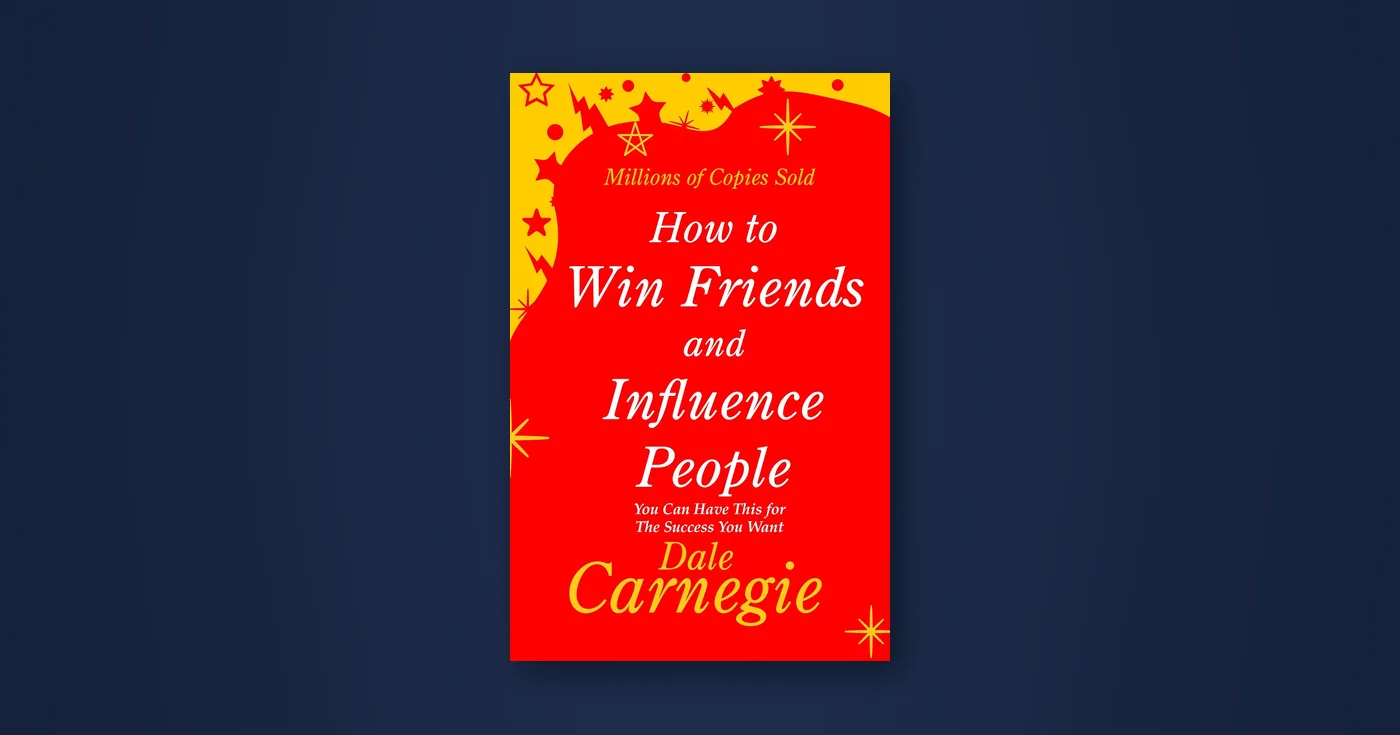
How to Win Friends and Influence People
Read it if…
- You want people to like you, trust you and listen to you, at work and at home.
- You find small talk awkward or forget names the moment you hear them.
- Your conversations too often turn into arguments nobody wins.
- You manage people and want them to change without feeling criticised.
- You've never read a self-help classic and want to start with the original.
Watch the summary

What the book is about
How to Win Friends and Influence People is a practical guide to getting on with other people. Dale Carnegie’s argument is that success at work and in life depends less on what you know and more on how you treat people: whether you listen, show real interest and make others feel valued.
The book grew out of Carnegie’s adult education courses in New York. Each chapter teaches one principle and backs it up with stories, from presidents and business leaders to ordinary people who used the ideas in his classes. First published in 1936, it has sold more than 30 million copies and is still one of the best-known books on people skills ever written.
What’s inside
Handling people Don’t criticise, condemn or complain. Give honest, sincere appreciation, and show people how what you want also gets them what they want.
Six ways to be liked Be genuinely interested in others, smile, remember names, listen well, talk about their interests and make them feel important.
Remember their name Carnegie treats a person’s name as the sweetest sound to them, and shows how remembering it builds goodwill fast.
Avoid the argument You can’t win an argument, he says, because even if you win, the other person resents it. Steer clear of them altogether.
Never say “you’re wrong” Respect other people’s opinions, and when you are the one who’s wrong, admit it quickly and openly.
Win people round Begin in a friendly way, get early agreement, let the other person do most of the talking and let them feel the idea is theirs.
Change without resentment As a leader, start with praise, call attention to mistakes indirectly and let people save face, so they want to improve.
Who wrote it
Dale Carnegie (1888 to 1955) grew up on a farm in north-west Missouri and began teaching public speaking classes in New York in 1912. His courses on public speaking and human relations became hugely popular, and in 1934 a Simon & Schuster editor who had taken one persuaded him to turn the course into a book. That book became this one. Carnegie went on to become a radio host and columnist, and his courses continue around the world today as Dale Carnegie Training.
What readers are saying
What they love: Readers enjoy Carnegie’s storytelling, saying the anecdotes make each principle easy to understand and remember. Many say it’s the most useful book they’ve read on understanding people and getting them on side. Managers find it helpful for leading teams and getting the best out of colleagues, and audiobook listeners describe it as a reminder of the basic decency we all know but often forget to practise.
What well-known names said: Warren Buffett has said the book changed his life, and The Times called it “the most successful self-help book of all time”.
Quick facts
- Author
- Dale Carnegie
- Publisher
- Vermilion in the UK, first published by Simon & Schuster
- Length
- 304 pages (UK paperback)
- Published
- November 1936, revised edition 1981
- Formats
- Paperback, ebook and audiobook, read by Andrew MacMillan
- Recognition
- Over 30 million copies sold, one of Time's 100 most influential books
- Reading time
- Around 6 to 7 hours
- Difficulty
- Easy. Short chapters built around stories.
Our verdict
If you want to get on better with people, at work, at home or with someone you've just met, this is the book to start with. Carnegie's principles, like showing genuine interest, remembering names and never telling someone they're wrong, are simple enough to try in your next conversation. It suits anyone who leads, sells or simply wants to be better company, and it reads best a chapter at a time. The unabridged audiobook runs just over seven hours.
WillYouRead.com is independent and not affiliated with the author or publisher.
More in Relationships and communication
- Attached by Amir Levine and Rachel Heller (coming soon)
- The 5 Love Languages by Gary Chapman (coming soon)
- Crucial Conversations by Kerry Patterson and co-authors (coming soon)
- Supercommunicators by Charles Duhigg (coming soon)
- Nonviolent Communication by Marshall B. Rosenberg (coming soon)
- Radical Candor by Kim Scott (coming soon)