Is this book for you?
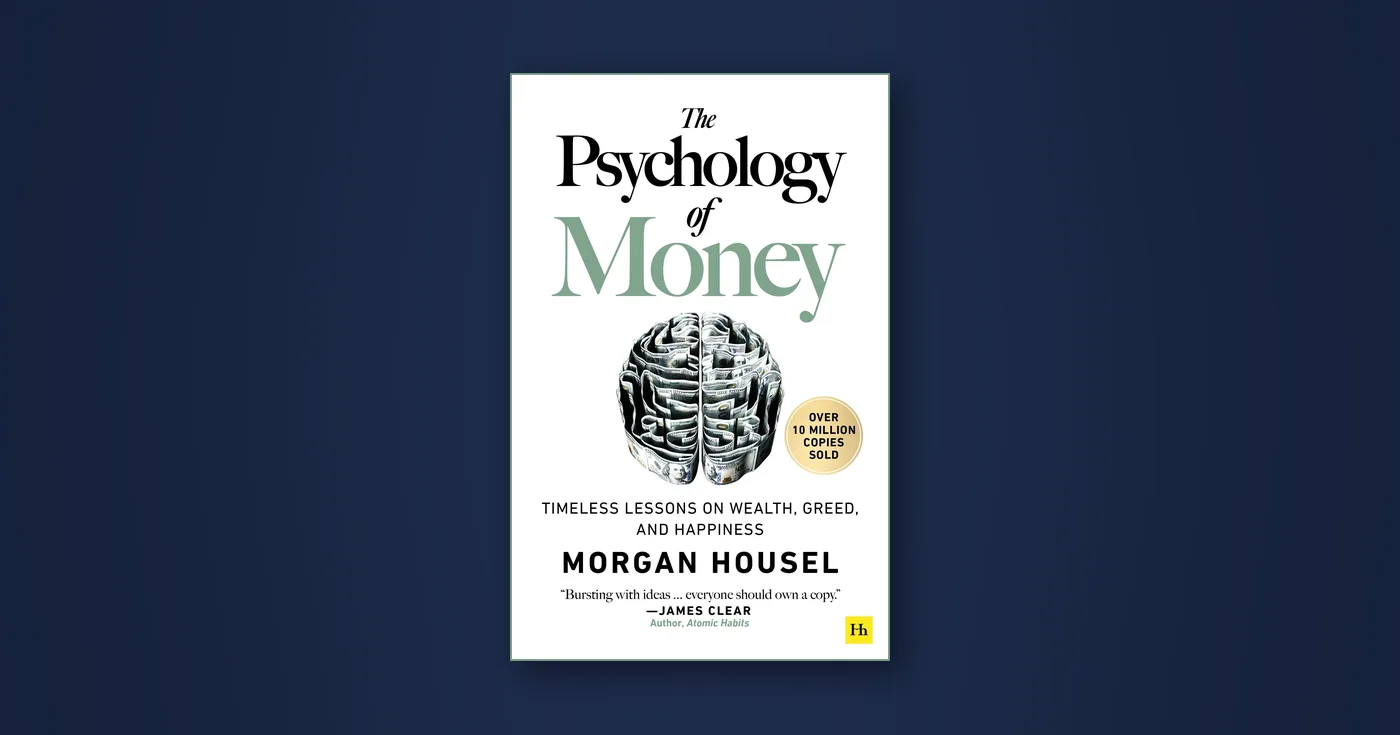
The Psychology of Money
Read it if…
- You earn decent money but never seem to feel any richer.
- You want to understand money without spreadsheets, jargon or formulas.
- You get anxious, or tempted, every time the markets move.
- You're starting out and want a sensible way to think about saving.
- You like short chapters you can read one at a time.
Watch the summary

What the book is about
Most money books treat finance like maths: get the formula right and the results follow. Morgan Housel argues the opposite. Doing well with money has less to do with what you know and far more to do with how you behave, and behaviour is hard to teach, even to very clever people.
The book is built from 19 short, standalone chapters. Each one uses a real story to show a quirk in how people think about money, from why a janitor can die richer than a Wall Street executive to why “enough” is the hardest number to find. It doesn’t tell you what to buy. It helps you understand why you make the choices you do.
What’s inside
No one’s crazy Your money habits make sense once you know what you lived through. Someone who grew up in high inflation sees risk very differently from someone who grew up in a boom.
Luck and risk Success and failure both owe more to chance than we like to admit, so be careful who you copy and how hard you judge yourself.
The power of compounding The vast majority of Warren Buffett’s fortune came after his 65th birthday. His real secret was starting young and never stopping.
Getting rich versus staying rich Making money takes boldness. Keeping it takes humility, frugality and a healthy fear of losing it.
Wealth is what you don’t see Expensive cars and big houses show money spent. Real wealth is the money you never spent, which is why it stays invisible.
Save for no reason You don’t need a goal to save. Savings buy options, and the freedom to control your own time is the highest return money can pay.
Leave room for error Plans fail. A margin of safety lets you survive the bad years so compounding can do its work.
Know when you have enough Moving the goalposts after every win is how people risk what they need for things they don’t.
Who wrote it
Morgan Housel is a partner at The Collaborative Fund, a venture capital firm, and a former columnist at The Motley Fool and The Wall Street Journal. He has twice won the Best in Business Award from the Society of American Business Editors and Writers, won the New York Times Sidney Award, and been a finalist for the Gerald Loeb Award for financial journalism twice. He has since written Same as Ever and The Art of Spending Money.
What readers are saying
What they love: Readers say it’s the money book they wish they’d read first. The stories are memorable, the chapters are short, and there’s no jargon to wade through. Many say it changed how they feel about saving and spending, not just what they know, and that the lessons apply whatever you earn.
What they don’t: Some readers find it repetitive, with the same few ideas returning in different stories. Others wanted more practical steps and were disappointed there’s little on budgeting or how to invest. Reviewers also point out that it’s built on stories rather than research, so the evidence behind some lessons is uneven, and UK readers note that its examples lean heavily American.
What well-known names said: Bestselling author Daniel H. Pink called it “an essential read for anyone who wants to make wiser decisions”. Annie Duke, author of Thinking in Bets, praised it for explaining both why we make bad money decisions and how to make better ones.
Quick facts
- Author
- Morgan Housel
- Publisher
- Harriman House
- Length
- 256 pages
- Published
- 8 September 2020 (paperback)
- Formats
- Paperback, hardback, ebook and audiobook, read by Chris Hill
- Recognition
- Sunday Times number one bestseller, over 10 million copies sold
- Reading time
- Around 4 to 5 hours
- Difficulty
- Easy. No finance background needed.
Our verdict
If you've ever wondered why clever people make bad money choices, this is the book to start with. Morgan Housel's 19 short chapters, from compounding to knowing when you have enough, change how you think about saving, risk and spending. It's about behaviour rather than budgets, so if you want step-by-step investing instructions, pair it with a more practical guide. The chapters are short enough to read one a night, and the audiobook, read by Chris Hill, runs just under six hours.
WillYouRead.com is independent and not affiliated with the author or publisher. This page is not financial advice. For decisions about your own money, speak to a qualified, regulated adviser.
More in Money
- Rich Dad Poor Dad by Robert Kiyosaki (coming soon)
- The Richest Man in Babylon by George S. Clason (coming soon)
- I Will Teach You to Be Rich by Ramit Sethi (coming soon)
- Die With Zero by Bill Perkins (coming soon)
- The Simple Path to Wealth by JL Collins (coming soon)
- Your Money or Your Life by Vicki Robin and Joe Dominguez (coming soon)