Is this book for you?
Spark
Read it if…
- You know exercise is good for you but can't get yourself moving.
- You want to feel calmer, sharper and less stressed day to day.
- You or someone close to you struggles with focus, anxiety or low mood.
- You like real science and real stories, not just motivational talk.
- You're a parent, teacher or coach who wants children to learn better.
Watch the summary
What the book is about
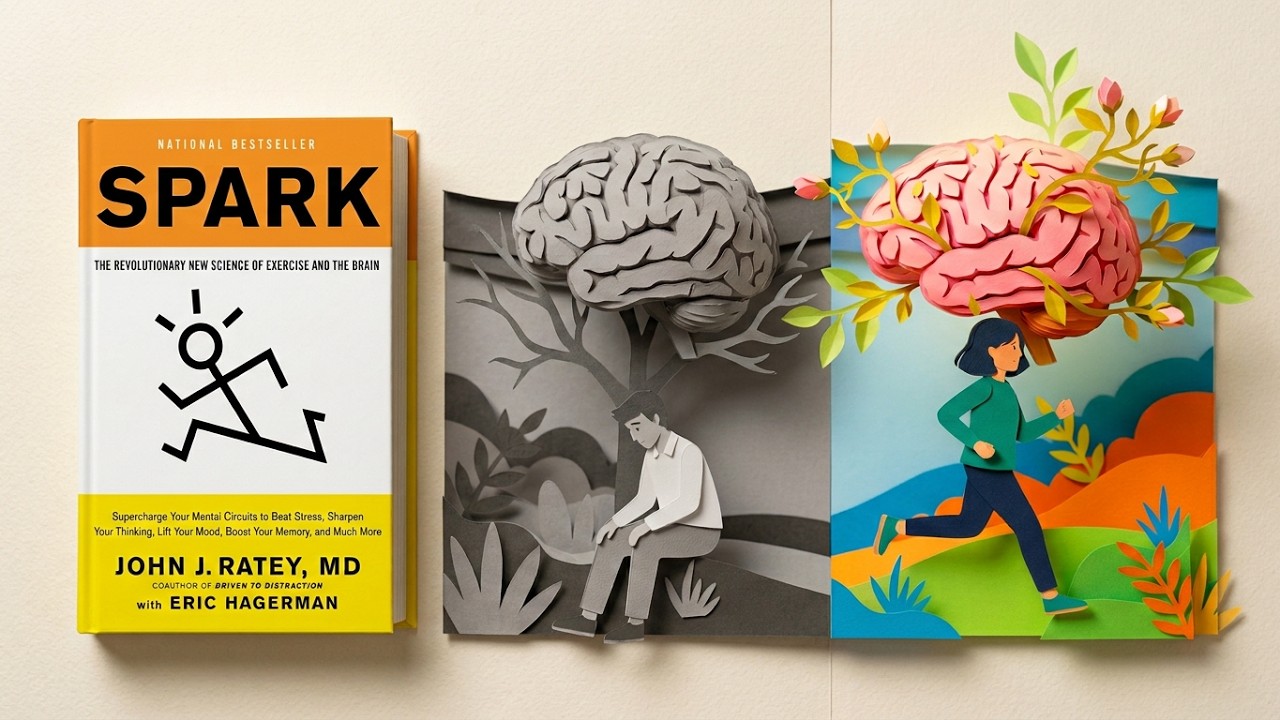
Most of us exercise for our bodies: to lose weight, protect our hearts or fit into our jeans. Spark argues we’ve been missing the main event. Psychiatrist John Ratey makes the case that aerobic exercise physically reshapes the brain, helping you handle stress, lift your mood, protect your memory and think more clearly.
He builds the case from research and from real people, starting with a school district in Illinois that put fitness at the heart of the school day and saw its pupils thrive in the classroom. Chapter by chapter, he shows how movement helps with learning, stress, anxiety, depression, attention, addiction, hormonal change and ageing, with practical advice on the kind of exercise that helps in each case.
What’s inside
Exercise rebuilds the brain Your brain behaves like a muscle: it grows with use and withers without it. Exercise helps brain cells sprout new branches and connect more strongly.
Miracle-Gro for the brain Ratey’s starting point is BDNF, a protein that helps brain cells grow, survive and link up. Exercise raises it throughout the brain.
The Naperville experiment A before-school PE class in Illinois swapped team sports for personal fitness. Students who joined improved their reading far more than classmates who didn’t.
Calmer under stress Why a workout trains your body and brain to handle pressure better, so everyday stress hits less hard.
Anxiety and low mood How regular movement can ease anxiety and lift depression, and why Ratey sees it as part of treatment, not an extra.
Focus and attention Exercise helps the brain’s focus systems work better, which makes it a powerful tool for anyone with ADHD.
Addiction, hormones and ageing How movement helps people resist cravings, steadies the body through hormonal changes such as menopause, and protects the brain against decline in later life.
Your own plan Practical guidance on the type and amount of aerobic exercise that helps, so you can build your own routine.
Who wrote it
John J. Ratey MD is an Associate Clinical Professor of Psychiatry at Harvard Medical School and an internationally recognised expert in neuropsychiatry. He has served as an adjunct professor of sport science at the National Taiwan Sport University, and keeps a private practice in Cambridge, Massachusetts and Los Angeles.
He is best known for his work on attention: he co-wrote Driven to Distraction and ADHD 2.0 with Edward Hallowell, and wrote A User’s Guide to the Brain. Spark was written with Eric Hagerman.
What readers are saying
What they love: Readers say the book finally explains why exercise makes them feel so good, and many say it gave them the push to start moving and keep going. The Naperville story is a favourite, because it shows the science working for real children in a real school. Mental health professionals praise how thoroughly it covers learning, memory, mood and attention, and the practical advice in every chapter.
What well-known names said: Ken Duckworth MD, medical director of the US National Alliance on Mental Illness, wrote: “In mental health, exercise is a growth stock and Ratey is our best broker.” The Daily Mail praised it as the first book to pull together evidence from around the world that the fitter you are, the better your brain works. Reviewers often compare it to Kenneth Cooper’s work on aerobics, saying Ratey did for the brain what Cooper did for the heart.
Quick facts
- Author
- John J. Ratey MD, with Eric Hagerman
- Publisher
- Little, Brown Spark (paperback)
- Length
- 304 pages
- Published
- 1 January 2013 (paperback). First published in 2008
- Formats
- Paperback, ebook and audiobook, read by Allan Robertson
- Recognition
- National bestseller, rated 4.1 out of 5 by over 17,000 Goodreads readers
- Reading time
- Around 7 to 8 hours
- Difficulty
- Moderate. Real brain science, explained in plain English.
Our verdict
If you know you should move more but never quite manage it, this book will change how you see every workout. Harvard psychiatrist John Ratey shows how exercise boosts BDNF, a protein he calls Miracle-Gro for the brain, and why that lifts mood and sharpens focus. It suits curious readers who enjoy real science and real stories, especially parents and teachers. The unabridged audiobook runs just under ten hours, so it makes a good companion on your next walk.
WillYouRead.com is independent and not affiliated with the author or publisher. This page is not medical advice. If you're struggling with your mental or physical health, please speak to your GP.
More in Health and body
- Why We Sleep by Matthew Walker
- Outlive by Peter Attia (coming soon)
- Breath by James Nestor
- The Comfort Crisis by Michael Easter (coming soon)
- Burnout by Emily and Amelia Nagoski (coming soon)
- Glucose Revolution by Jessie Inchauspé