Is this book for you?
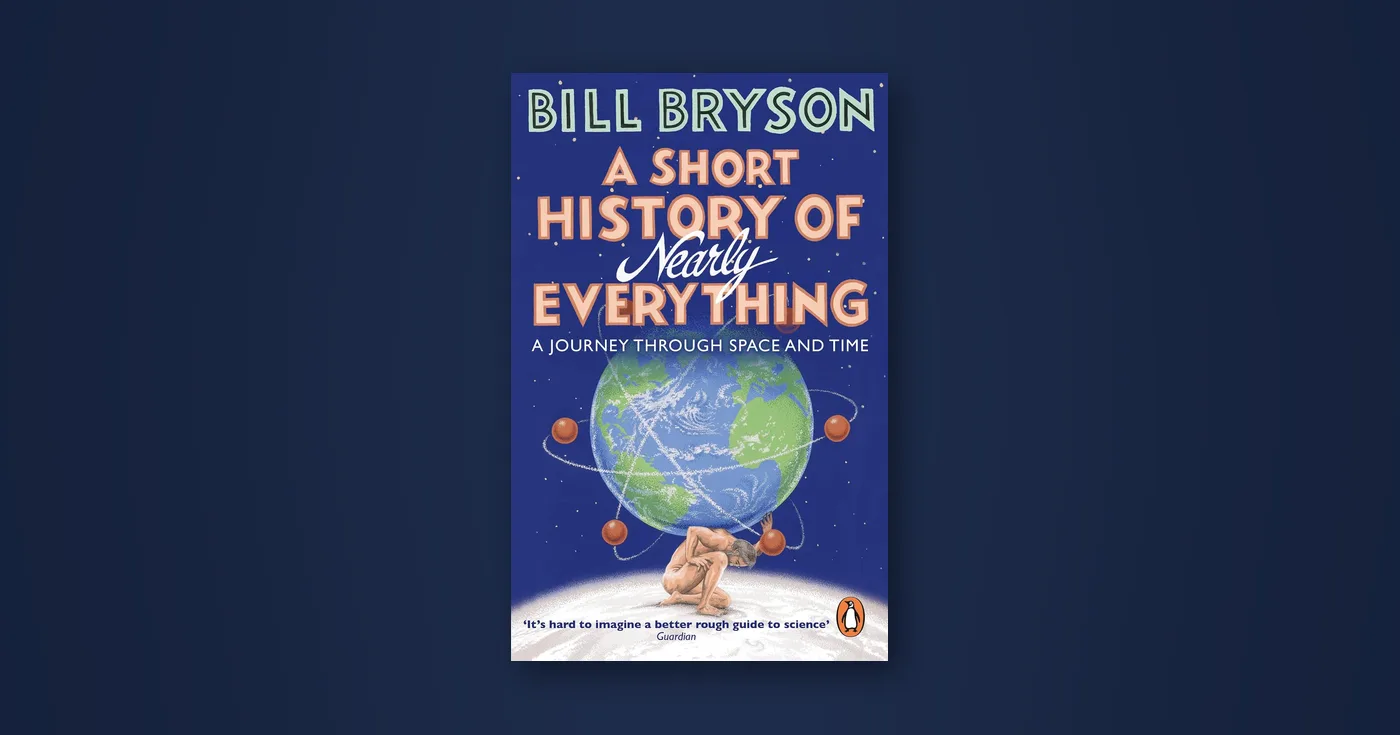
A Short History of Nearly Everything
Read it if…
- You were put off science at school but still wonder how the world really works.
- You love Bill Bryson's travel writing and want that humour turned on science.
- You want one book that covers space, the Earth, atoms and life in plain English.
- You enjoy stories about the odd, obsessive people behind big discoveries.
- You read the original years ago and want to catch up on twenty years of science.
Watch the summary
What the book is about
Bill Bryson realised he knew almost nothing about the planet he lived on, so he set out to find out. The result is a journey from the Big Bang to the rise of human civilisation: how we went from nothing at all to us.
What makes it different is the question underneath. Bryson isn’t just interested in what scientists know, but in how they ever worked it out. How do we know what’s at the centre of the Earth, how old the universe is, or where the continents sat millions of years ago? The 2.0 edition brings all of it up to date with two decades of new discoveries.
What’s inside
From nothing to everything The Big Bang, how the universe took shape, and just how vast and empty space really is.
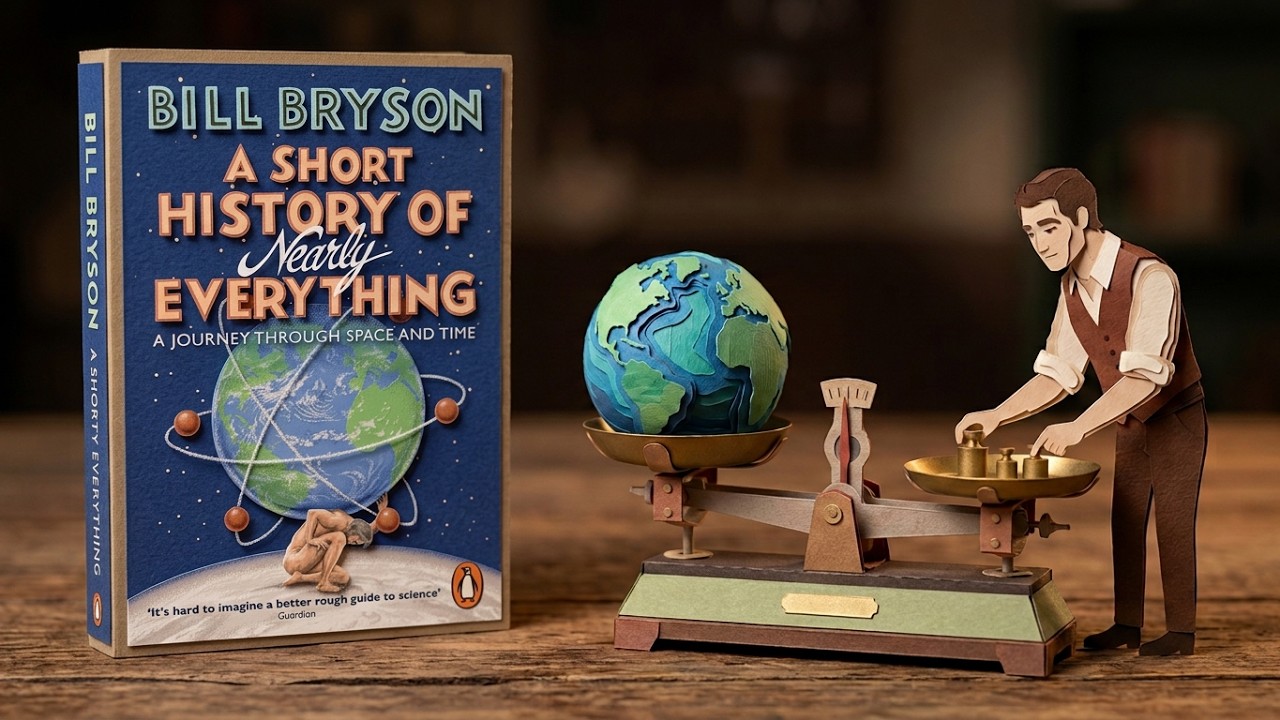
Sizing up the Earth How people weighed, measured and dated the planet, often with homemade equipment and sheer stubbornness.
The very small Atoms, particles and the forces that hold everything together, including how the Higgs boson changed physics.
A dangerous planet Volcanoes, earthquakes and asteroids, and how close life has come to being wiped out.
Life itself How life began, what cells and DNA actually do, and how unlikely it is that any of us are here.
The road to us Where humans came from, and how genetics has revealed early human species nobody knew existed.
What’s new in 2.0 Why Pluto lost its planet status, why the solar system has more than twice as many known moons, and why most of the universe is still a mystery.
The people behind it The brilliant, eccentric and often overlooked scientists whose rivalries and wrong turns led to what we know today.
Who wrote it
Bill Bryson was born in Des Moines, Iowa, in 1951 and has lived most of his adult life in Britain. He has written eighteen books and holds the record for the most bestsellers of any author on the Sunday Times list in the last fifty years. He’s best known for travel books such as Notes from a Small Island and A Walk in the Woods.
He is a former Chancellor of Durham University and an Honorary Fellow of the Royal Society. He lives in England.
What readers are saying
What they love: Readers say Bryson makes hard subjects feel easy and genuinely fun. They love his jokes, his eye for strange stories and his honesty about what he didn’t know. Many say it changed how they see the world around them, and that it’s the science book they wish they’d had at school. Since 2003 it has sold over two million copies and spent 106 weeks in the bestseller chart.
What well-known names said: The Economist called it “possibly the best scientific primer ever published”. The Guardian said it was hard to imagine a better rough guide to science, and The Times described it as a science travelogue with a witty, well-informed guide.
Quick facts
- Author
- Bill Bryson
- Edition
- 2.0, fully revised and updated (first published 2003)
- Publisher
- Doubleday (Penguin Random House)
- Length
- 656 pages
- Published
- 21 October 2025 (hardback)
- Formats
- Hardback, ebook and abridged audiobook, read by the author
- Recognition
- Winner of the Aventis Prize and the Descartes Prize. The biggest-selling popular science book of the 21st century.
- Reading time
- Around 12 to 15 hours
- Difficulty
- Easy to follow. No science background needed.
Our verdict
If you've ever felt science passed you by, this is the book to get. Bill Bryson asks how we actually know what we know, and answers with funny, vivid stories of the people who found out. It suits curious readers who like to take it a chapter at a time, and it's a great gift for a teenager. The fully revised 2.0 edition adds twenty years of new discoveries, and the audiobook is read by Bryson himself.
WillYouRead.com is independent and not affiliated with the author or publisher.
More in Big ideas, science and history
- Sapiens by Yuval Noah Harari (coming soon)
- Guns, Germs, and Steel by Jared Diamond (coming soon)
- Humankind by Rutger Bregman (coming soon)
- Freakonomics by Steven D. Levitt and Stephen J. Dubner (coming soon)
- Outliers by Malcolm Gladwell (coming soon)
- The Tipping Point by Malcolm Gladwell (coming soon)